DESCRIPTION OF CRC ROBOTICS COMPETITION
The 2025 CRC Robotics Competition is thrilling game of ingenuity and teamwork, where student teams like us come from across Canada pushed the boundaries of engineering and robotics. The competition challenged us to design and build robots capable of navigating intricate obstacle courses and completing complex tasks within a specific timeframe. This year’s theme, “TAKTIK” consists of strategy, teamwork, and speed.


The competition creates a collaborative and supportive environment where we students can learn skills such as problem-solving, critical thinking, teamwork, and project management. The experience allows us to explore mechanics, electronics, programming, and design principles that can help us create a positive impact on the world.
CRC TAKTIK GAME INTRODUCTION AND DESCRIPTION
TAKTIK is a strategic and dynamic team game played on a 3×3 grid, where teams use robots to control various stations by placing colored rings on designated targets. With only 5 minutes of game time, the objective of this game is to gain control of the most stations in a tic-tac-toe format, aiming for three stations in a row, column, or diagonal. Each station has unique rules and scoring opportunities, creating a varied and strategic game.
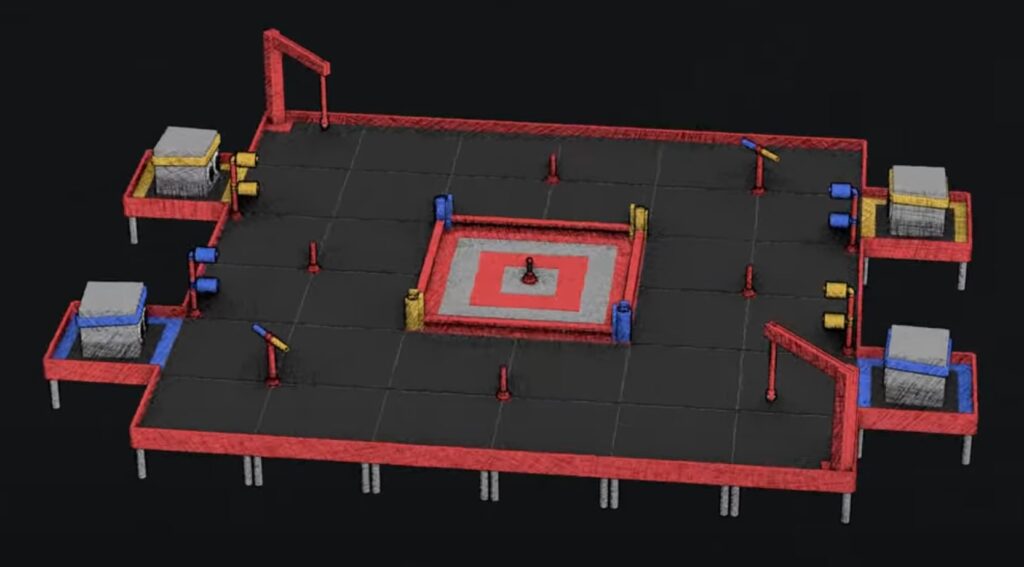


Game Pieces and Teams
In TAKTIK, each team uses rings in their assigned color, either yellow or blue. Teams are composed of two robots, and each robot can carry up to three game pieces at a time. Robots can gather game pieces from designated stacks or hooks, but they are only allowed to interact with pieces in their own team color. At the beginning of the game, no rings are pre-stacked.


Types of Stations and Scoring
The TAKTIK game board contains four types of stations, each with its own rules and point structure.
1. Ring Catcher: In this station, teams earn 20 points per ring placed. The last team to place a ring on the Ring Catcher wins control of this station. Its height varies between 6 and 24 inches, adding a physical challenge for the robots in each match.
2. Inverted Catcher: In this station rewards 40 points per ring. The first team to successfully place a ring wins the station, making it a race to establish control quickly.


3. The Duel: This station awards 30 points per ring and has space for each team to place up to 8 rings. The team that places the most rings on their side of the Duel wins control of this station. This setup emphasizes both offensive and defensive play, as teams must aim to maximize their own rings while preventing the opposing team from doing the same.
4. The Zone: The Zone features a progressive scoring system based on proximity to the center. Points start at 5 and increase incrementally (e.g., 5, 10, 15, 20) the closer the rings are placed to the center. The middle pole is especially valuable, with the first ring placed there worth 500 points; however, each additional ring decreases by 100 points. Only five rings can be placed in The Zone, and the team with the most rings closest to the center gains control of the station.


Winning Strategies
The game board’s 3×3 grid requires teams to think strategically, as each station occupies one square on the board. Gaining control of stations in a row, column, or diagonal forms a tic-tac-toe and gives the team a 50% point increase for those stations. Stations that contribute to two tic-tac-toe lines see their points doubled, creating high-stakes competition for central and strategically positioned stations.